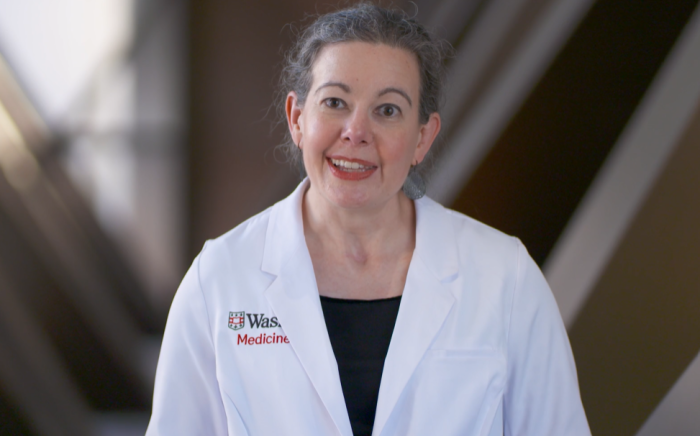
She Left Nursing, Then Returned
Meg Mohr, RN, MSN(R), joined St. Louis Children’s Hospital in 1988 as a staff nurse in the Newborn ICU. After completing her master’s degree in 1992, she left to work at another hospital as a cardiothoracic (CT) surgery clinical nurse specialist (CNS). She eventually decided to stay at home full time with her two children.
As her kids grew older, Mohr realized how much she missed working with infants. She re-entered the workforce as a staff nurse in the Special Care Nursery at Missouri Baptist Medical Center. After three years, she returned to St. Louis Children’s Hospital in 2007 as the clinical educator for the new Cardiac ICU. She shares insight on her role:
What brought you to your current position? I wanted to explore clinical leadership roles in nursing. I learned about the clinical educator position for the Cardiac ICU and thought that would be a great fit given my love of neonates and kids with congenital heart disease, and my previous experience as a CT Surgery CNS. I couldn’t be happier that my career has landed me back at St. Louis Children's Hospital working with patients with heart disease.
What is the most rewarding part of your job? The most challenging?In the fast-paced role of intensive care, bedside nurses have many things to remember and many tasks to perform. Their attention to detail must occur within the framework of understanding each patient’s complex heart disease. I help by coordinating learning opportunities, communicating pertinent housewide information, tracking of competency requirements or periodically being an extra set of hands at the bedside. It’s rewarding to prepare Cardiac ICU bedside nurses for their high-tech role.
Another rewarding part of my job is to coordinate the orientation of new nurses hired into the Cardiac ICU. This includes organizing clinical and class time for the new graduate nursing interns who complete a six-month orientation before working in the Cardiac ICU.
It’s great to see the transformation of the novice nurse into one who is a confident, knowledgeable team member. The four nurses who completed the Cardiac ICU nursing internship last year are now serving on committees, attending conferences and acting as preceptors. One was even named SLCH “Rookie of the Year” during National Nurses Week.
The most challenging part of my job has been handling requests for staff education. It won’t work to inundate the staff with new equipment, new policies, new requirements and more all at once. Priorities need to be set, and effective education needs to be planned to implement changes or reinforce current practice and knowledge.
So how do you keep education fresh and new for seasoned staff members?I ask staff what information they want, what they think they need and suggestions on how they want thatinformation presented. I established a unit-based Education Council consisting of a diverse team of seasoned, newer, night shift and day shift staff members that discusses different ways to address the needs of all nurses in our unit. Aside from the Education Council, I seek input from management, physicians and general staff when assessing educational needs, and I constantly search for new ways to offer education that is current and useful.
What skills and knowledge must new staff members have before they are taking care of patients on their own?There is an extensive orientation in the Cardiac ICU for newly hired staff. Each nurse has 15–30 orientation shifts at the bedside as well as observation experiences in the clinic, Heart Station, Cardiac Cath Lab and Operating Room. The nurse is also expected to complete several Cardiac ICU curricula on the computer-based learning system. When this process is nearing completion, I talk with each nurse and respective preceptors about the individual’s confidence level with patient care in the Cardiac ICU and
all that it entails.
How do you promote professional development among your staff?As a unit, we work hard every day to ensure that the care we are giving to our complex patients is the best evidence-based care available. We encourage nurses to attend national conferences and network with other professionals. We are excited this year because the Cardiac ICU Medical Director is also the Program Director of the Pediatric Cardiac Intensive Care Society (PCICS) conference in December. We will have several poster presentations at the PCICS meeting. Our goal is to showcase our hospital’s Cardiac ICU at the conference.
If I want to be a clinical educator at SLCH someday, what should I be doing now?If you love to learn and share your knowledge, first and foremost you should learn about yourself. It should be important to learn about different types of people, types of learning styles, adult learning principles and how to communicate effectively. In addition to a BSN, you would need experience in the clinical area in which you hope to be an educator. Finally, good prioritization and organizational skills are a plus.
Meg Mohr may be reached at
mgm4240@bjc.org.