
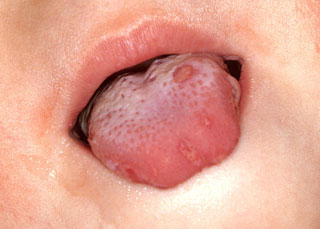
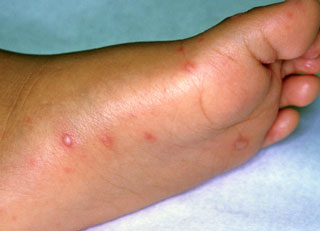
Is this your child's symptom?
- Tiny red spots and water blisters on the hands and feet caused by a virus
- Rash is seen on the palms, fingers, soles and toes
- The diagnosis cannot be made without these
- Also can cause small mouth ulcers (sores)
Next Steps
Causes
Symptoms of Hand-Foot-and-Mouth Disease (HFMD)
- Small red spots and tiny water blisters on the hands and feet. Seen on the palms, fingers, soles and toes.
- The diagnosis cannot be made without these.
- Small painful ulcers (sores) in the mouth. Look for them on the tongue and sides of mouth. Most children with HFMD have these, but they can be hard to see.
- Also, small blisters or red spots on the buttocks (30%)
- Low-grade fever less than 102° F (39° C)
- Mainly occurs in children age 6 months to 4 years
Cause of HFMD
- Coxsackie A-16 virus and other enteroviruses
- Not related to any animal disease
Severe Form of HFMD
- Since 2012, a severe form of HFMD has occurred in much of the world. It's caused by a new Coxsackie A6 virus.
- The rash spreads to the arms, legs and face. The rash is made up of many small blisters.
- Children with such a severe rash may need to be seen. Reason: to confirm the diagnosis. Exception: close contact with HFMD within the last 7 days.
- Treatment is the same. Drink enough fluids to prevent dehydration.
- Peeling of the fingers and toes is common. It looks bad but is harmless. It happens at 1 to 2 weeks. Use a moisturizing cream on the raw skin.
- Some fingernails and toenails may fall off. It occurs in 4% of severe cases. It happens at 3 to 6 weeks out. Trim them if they catch on things.
- Fingernails grow back by 3 to 6 months and toenails by 9 to 12 months. They will look normal.
Care Advice for Hand-Foot-and-Mouth Disease (HFMD)
- What You Should Know About HFM Disease:
- Most often, hand-foot-and-mouth disease (HFMD) is a harmless rash.
- It is caused by a virus called Coxsackie.
- Here is some care advice that should help.
- Liquid Antacid for Mouth Pain (Age 1 Year and Older):
- For mouth pain, use a liquid antacid (such as Mylanta or the store brand). Give 4 times per day as needed. After meals often is a good time.
- Age 1 to 6 years. Put a few drops in the mouth. Can also put it on the mouth sores with a cotton swab.
- Age over 6 years. Use 1 teaspoon (5 mL) as a mouth wash. Keep it on the ulcers as long as possible. Then can spit it out or swallow it.
- Caution: Do not use regular mouth washes, because they sting.
- Fluids and Soft Diet:
- Try to get your child to drink adequate fluids.
- Goal: Keep your child well hydrated.
- Cold drinks, milk shakes, popsicles, slushes, and sherbet are good choices.
- Solid Foods. Offer a soft diet. Good ones are mac and cheese, mashed potatoes, cereals with milk and ice cream. Also, avoid foods that need much chewing. Do not give citrus, salty, or spicy foods. Note: Fluid intake is more important than eating any solids.
- For babies, you may need to stop the bottle. Give fluids by cup, spoon or syringe instead. Reason: The nipple can increase the pain.
- Pain Medicine:
- Mouth sores are painful.
- Blisters also may be painful, especially on the feet.
- To help with the pain, give an acetaminophen product (such as Tylenol).
- Another choice is an ibuprofen product (such as Advil).
- Use as needed.
- Fever Medicine:
- For fevers above 102° F (39° C), give an acetaminophen product (such as Tylenol).
- Another choice is an ibuprofen product (such as Advil).
- Note: Fevers less than 102° F (39° C) are important for fighting infections.
- For all fevers: Keep your child well hydrated. Give lots of cold fluids.
- Blisters on the Skin
- Blisters don't need any special treatment. You can wash them like normal skin.
- Blisters on the palms and soles do not open.
- Those on arms and elsewhere sometimes open. The fluid is contagious to other people. Open blisters do not need to be covered. They quickly dry over.
- Return to School:
- HFMD is easily spread to others.
- However, most often, it's a mild and harmless illness.
- After contact with HFMD, children come down with symptoms in 3-6 days.
- Can return to child care or school after the fever is gone. Most often, this takes 2 to 3 days.
- Children with widespread blisters may need to stay home until the blisters dry up. That takes about 7 days.
- What to Expect:
- Fever lasts 2 or 3 days.
- Mouth sores should go away by 7 days.
- Rash on the hands and feet lasts 10 days. The rash on the hands and feet may then peel.
- Call Your Doctor If:
- Signs of dehydration occur
- Fever lasts more than 3 days
- You think your child needs to be seen
- Your child becomes worse
And remember, contact your doctor if your child develops any of the 'Call Your Doctor' symptoms.
When to see a Doctor
Go to ER Now
- Stiff neck, severe headache or acts confused
- Weakness in the arms or legs, such as trouble walking
Call Doctor or Seek Care Now
- Dehydration suspected. No urine in more than 8 hours, dark urine, very dry mouth and no tears.
- Your child looks or acts very sick
- You think your child needs to be seen, and the problem is urgent
Contact Doctor Within 24 Hours
- Red, swollen and tender gums
- Ulcers and sores also on the outer lip
- Rash spreads to the arms and legs (severe form of HFMD)
- Fever lasts more than 3 days
- You think your child needs to be seen, but the problem is not urgent
Contact Doctor During Office Hours
- Fingernails or toenails fall off
- You have other questions or concerns
Self Care at Home
- Hand-foot-mouth disease and no other problems
If NOT, try one of these:
Disclaimer: this health information is for educational purposes only. You, the reader, assume full responsibility for how you choose to use it.