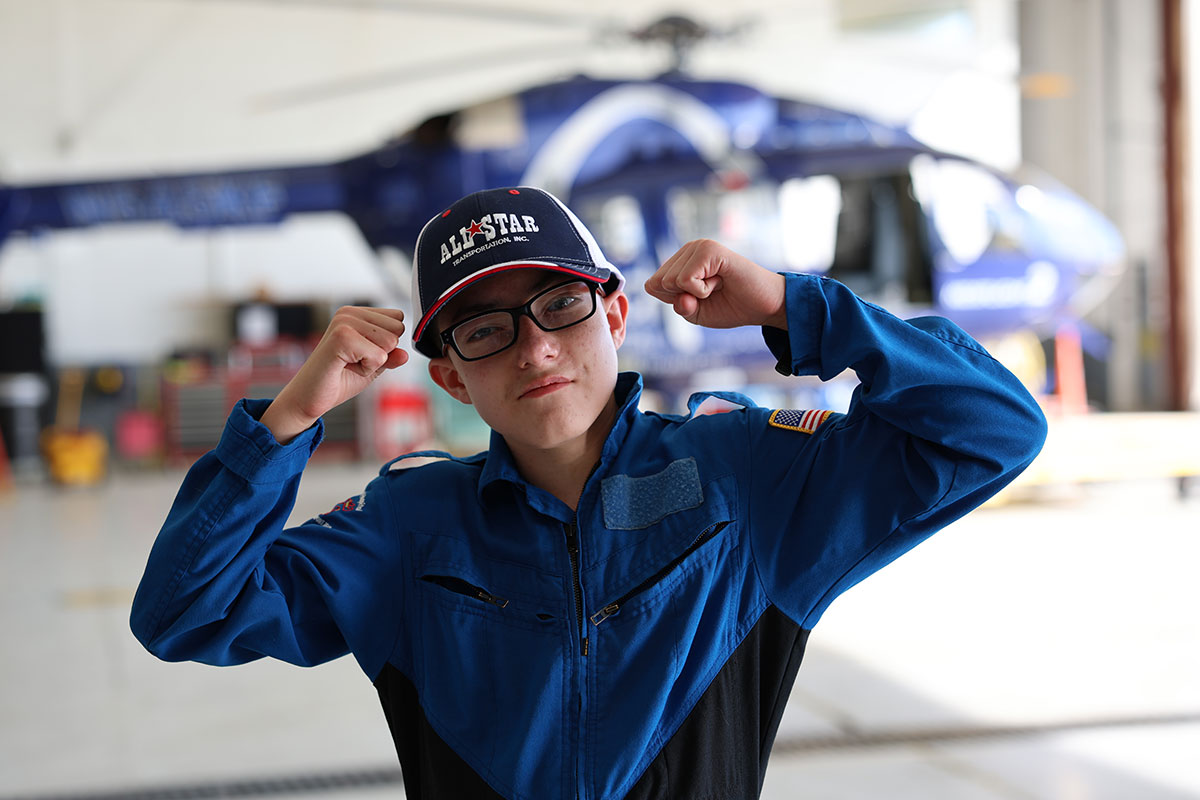
EJ is your typical 14-year-old boy. He loves playing video games, is an active swimmer, and enjoys riding around on his hoverboard. But for many years, EJ had been limited from participating in certain activities due to his scoliosis diagnosis. Recently, he took a big step in his health care journey when he had corrective scoliosis surgery at St. Louis Children’s Hospital and WashU Medicine to repair the curvature in his spine.
EJ’s relationship with St. Louis Children’s and WashU Medicine began when he was 3 years old, but it wasn’t due to his spine. He developed a bad cough and had difficulty breathing while on vacation in Jefferson City, Missouri, visiting his grandparents. The cough was a symptom of an upper respiratory infection. Though this may not sound alarming to most parents, for EJ’s mom, Rita, it was concerning given his complex health history.
EJ was born with DiGeorge syndrome, a genetic disorder in which a tiny piece of chromosome 22 is missing. It can cause many health problems including heart irregularities and scoliosis. EJ was also diagnosed with pulmonary atresia (PA), an abnormal development of the pulmonary valve. Without surgery to correct it, the heart can’t pump oxygenated blood to the body. At only eight days old, EJ had what would become the first of four heart surgeries.
When Rita notified the doctors in Jefferson City about EJ’s heart conditions, they decided he should be airlifted to the St. Louis Children’s Hospital and WashU Medicine Heart Center.
“That was our first exposure to St. Louis Children’s,” Rita says. “From that moment I thought, ‘This is how a hospital should be.’ I didn’t have to worry. It was such a good feeling knowing these people would take care of us.”
Rita and EJ ended up spending a month at St. Louis Children’s to treat his infection. When EJ was discharged, Rita decided that she and EJ would permanently move from their home in North Dakota to St. Louis to be closer to the Heart Center for his follow-up heart surgeries.
Over the years, EJ took advantage of the many amenities St. Louis Children’s provides. When he first arrived, he would play with the board games and toys in the Child Life Playroom. Later, he got to spend time with Sweety, a miniature horse, who visits patients in the Purina Family Pet Center. Most recently, he had his picture taken with NHL hockey player and St. Louis native, Matthew Tkachuk, when he brought the Stanley Cup to St. Louis Children’s.
“We’re always amazed at the steps the staff takes to make sure the kids are happy,” Rita says. “Even though he’s been stuck in the hospital at times, he’s had opportunities that are so cool.”
Overcoming another challenge
A decade later, with multiple heart surgeries behind him, EJ and Rita decided to address the scoliosis in EJ’s spine, which was getting worse.
“Our pediatric spine surgeons diagnose scoliosis when there’s a 10-degree curve in the back,” says Lindley Wall, MD, MSC, WashU Medicine chief of pediatric and adolescent orthopedics. “When our surgeons treat curves in the spine that are between 20 and 50 degrees for kids who are still growing, we do have a treatment option of using spinal bracing. However, EJ didn’t fit into that category because his curve was already sizable.”
There was never a question of “if” EJ needed spine surgery, but more of “when.” With a spinal curvature greater than 60 degrees and growing, his spine could eventually begin to impact his lungs and heart. In speaking with Rita and EJ, their surgeon recommended a spinal fusion as the best course of action. This type of surgery involves fusing multiple bones in the spine into one to stop a curve from getting bigger and to correct deformity.
Advancements in scoliosis surgery, some of which were pioneered by former WashU Medicine orthopedic surgeons, have made spinal procedures safer and have cut down on the time patients have to stay in the hospital.
WashU Medicine pediatric spine surgeons use advanced navigation imaging that allows them to more accurately place screws and rods on either side of the spinal cord. Along with other advances, this technology has improved surgical safety and reduced hospital stays from weeks to just two or three days.
A spinal fusion is a complex and lengthy procedure. Given EJ’s cardiac history, two spine surgeons were present during surgery. WashU Medicine pediatric and adolescent orthopedic spine surgeon Brian Kelly, MD, worked closely with anesthesiology colleagues and EJ’s cardiac team at the Heart Center to prepare EJ medically for the procedure and carefully monitor his heart function throughout surgery.
Pediatric spine surgery can be lengthy, but the multidisciplinary team at St. Louis Children’s works together with a shared goal: improving a child’s quality of life.
Walking tall
Although the four-hour procedure was a success, EJ still had a long recovery. His activity level was restricted for six months to allow time for the bones to properly fuse together and for his incision to heal. That meant no swimming and definitely no hoverboarding. Rita, who is a personal trainer, would encourage EJ to go for short walks with her.
“He gained two inches in height after the surgery,” Rita says. “I feel like there’s a confidence level now that wasn’t there before the surgery. He walks a little taller. He’s looking forward to participating in PE class.”
After his surgery, EJ had the opportunity to attend a career camp and loved it. He took part in a flight simulation and got to speak to pilots. Since then, Rita thinks that when EJ grows up, he’ll want to become part of St. Louis Children’s Critical Care Transport team. This is a service that uses a highly specialized fleet of Mobile Intensive Care Units (MICUs), helicopters, and a fixed wing airplane to safely transfer patients to St. Louis Children’s. Each transport mission is tailored to meet the needs of the child or expectant mother being transported and is staffed by a specially trained medical team.
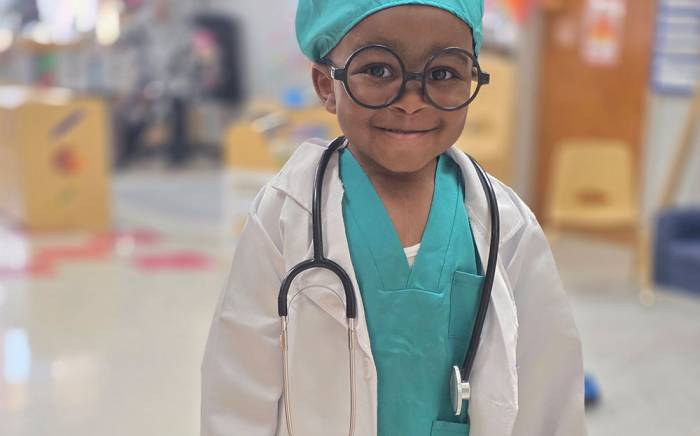
EJ has also expressed interest in becoming a doctor or a physical therapist. As Rita described it, he loves St. Louis Children’s and wants a job that will lead him back to the hospital so that he can be with all the people who have taken care of him.
The goal of surgery is to allow children like EJ to grow, stay active, and be a regular kid. EJ’s care team hopes that his scoliosis doesn’t slow him down and that he can pursue any career he chooses.
Learn more about St. Louis Children’s and WashU Medicine’s pediatric orthopedic program.